Painted portraits, posters and the desk
Updated
Hollywood Agent is drawn as a working office, not as a cinematic set. Steam's feature list calls the look a hand-painted art style: painted portraits for every actor, painted posters for every production, and an office-desk interface filled with folders, files, and paperwork. The studio page uses the same promise in shorter lines, "a face for every actor, a poster for every production," and then "an office desk full of folders, files and paperwork." The game is unreleased. The images on this page are the official Steam screenshots, 26 of them, all 1920 by 1080, checked on the store on 20 November 2026. The press kit offers its own packs and says those assets are free to use for coverage. News-site pictures are not used here.
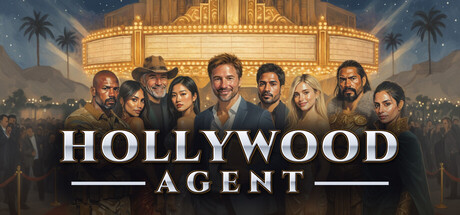
The store header is a separate piece of key art: a painted premiere crowd under a marquee, with the title Hollywood Agent across it. The capsule is the wordmark alone. Both are official, and both are logos and key art rather than the game screen. The screenshots are the game screen.
The desk that every screen sits on
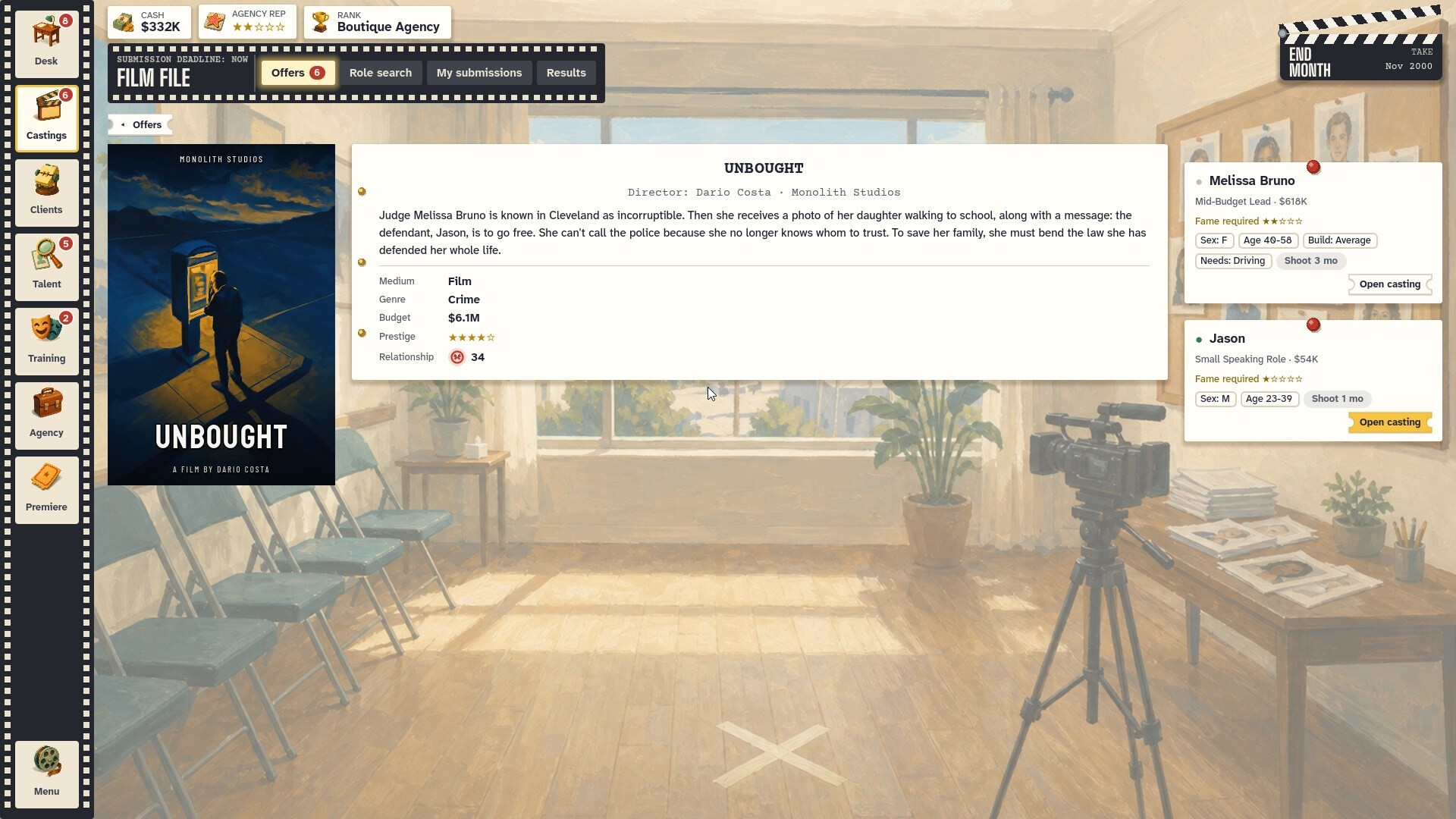
The English screenshots share one room. A wooden desk holds a rotary phone, a thick stack of papers, four painted headshots, a brass lamp, and a mug. A director's chair and a potted plant sit by a window that looks onto palms. The left rail is the same in each shot: Desk, Castings, Clients, Talent, Training, Agency, Premiere, and Menu. The top bar shows cash, a row of agency-reputation stars, and the rank Boutique Agency. A clapper in the corner reads End Month and the date November 2000. That chrome is the "office-desk interface" the feature list is talking about. The panels change. The room stays.
The German set uses the same paintings and the same desk, with the rail translated: Schreibtisch, Klienten, Talentsuche, Agentur, Premiere, Menü, and Castings and Training left in the original. The rank reads Boutique-Agentur, the clapper reads Monat beenden, and the date is Oktober 2000. Currency on those cards is marked Tsd. PC and languages uses that pair of boards as the language evidence. The art point is simpler: the localization changes the labels, not the paintings.
Portraits and posters
A client file hangs a painted portrait on the folder, the way a real agency would clip a headshot. Danny Fields, on the English file, is a painted bust in a jacket, and the Desk pins a whole row of similar portraits above the calendar, each with a name. The Talent cards use the same portrait style at a smaller size. The feature list's "painted portraits for every actor" is the rule those screens are demonstrating. The people are examples in the store images. Signing and training explains the file tabs around the portrait.
Posters get the same treatment. The Unbought film file opens with a painted poster of a figure at a payphone at night, the title set in the lower third like a one-sheet. Casting cards shrink that poster onto the cork board. The Premiere screen goes the other way and uses a full painted red carpet, velvet ropes, and a crowd as the wallpaper behind the monthly report. That carpet is the same world as the header key art, brought inside the interface. Casting and reviews reads the report that sits on top of it.
How many images, and which language
Steam's screenshot list on 20 November 2026 holds 26 images. They cover the desk, castings, client files, talent, training, finances, a ledger chart, the monthly report, and the German versions of those screens, including the office ladder and the rank ladder. The press kit page, checked the same week, describes an English pack of 30 images and a German pack of 25, and it also offers logo, key art, a vertical capsule, and hero art. The counts disagree because the packs are not the same set as the store gallery. The store gallery is the set reproduced here. The kit is the set the studio offers to press, linked from official links.
The monthly loop is easier to follow with the Desk open beside it, because the calendar is the turn. The money page is easier with the finances panel, because the tiles are the cash, the credit line, and the fixed costs. Nothing in the art is a substitute for a released game. The paintings show the interface the studio wants you to recognize. They do not show a balance sheet you can copy into a strategy guide.
Verdict: Trust the store screenshots and the press-kit art for how the game looks. Treat every name and fee inside them as a sample of the interface, and keep the wishlist on Steam until the paintings are attached to a build you can run.
FAQ
Are these screenshots from a released game?
They are the official images on the Steam store page for a game that is still coming soon. They show the interface. They are not a capture from a public release.
Why do some screens say End Month and others say Monat beenden?
The store set includes an English interface and a German interface. The paintings match. The labels change. That is the language support discussed on the platforms page.
Can I use the press-kit art?
The press kit says the assets are free to use for coverage and reviews, and it asks people not to alter the logos. This wiki uses the Steam gallery and the store header and capsule.
Is the whole game hand-painted?
That is the feature the studio and the store both claim: portraits, posters, and the desk. The screenshots are consistent with that claim. A released build is what would show whether every screen holds to it.
Sources: Steam store feature list and screenshots, Highground game page and press kit